
Public Stargazing Nights
Seasonal gatherings open to everyone, including meteor shower evenings at Hickory Nut Gap Farm in Fairview, just outside Asheville. Check the calendar for the next date.
View Events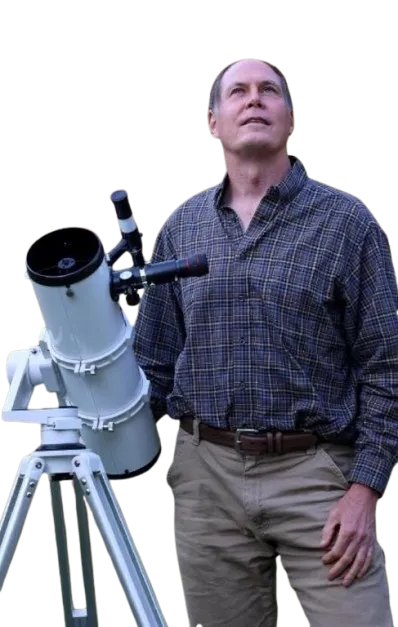
Astronomy Experiences · Western North Carolina
Guided stargazing in the Asheville area and Western North Carolina
Stargazing events, telescope views and astronomy programs with astronomer Stephan Martin, for people of all ages and backgrounds.
Telescopes, stories and wonder under Western North Carolina skies
For over 30 years I've guided people into direct encounters with the night sky and the evolving universe, through telescopes, story, ritual, and embodied cosmology.
I present stargazing opportunities for individuals and groups in Western North Carolina and elsewhere on a regular basis. I enjoy revealing the wonders of the night sky to people of all ages and backgrounds and showing them how to discover the wonders of the universe for themselves.
I studied physics and astronomy at Colgate University, researched dark matter in spiral galaxies at the University of Wyoming, supported Hubble Space Telescope observations at the Space Telescope Science Institute, and from 1998 to 2001 was one of the team scientists and organizers of the Williams College Solar Eclipse Expeditions.
I reveal the wonders of the night sky through telescopes, mythology, and contemplative practice.

Public nights, private groups and celebrations under the stars
Seasonal gatherings open to everyone, including meteor shower evenings at Hickory Nut Gap Farm in Fairview, just outside Asheville. Check the calendar for the next date.
View Events
Custom stargazing experiences are available for schools, nonprofits, outdoor centers, retreats, and private events.
Book a Night
Invite an astronomer to your wedding or celebration for an evening to remember beneath the stars.
Wedding StargazingJoin me for stargazing, workshops, and cosmic adventures
Dark-sky places within an easy drive of town
You don't have to travel far from Asheville to find a sky full of stars. Head up and away from the city lights, wait for a clear, moonless night, and let your eyes adjust.
City lights wash out much of the sky over downtown, so the higher overlooks and dark sky parks of the Blue Ridge are where the Milky Way returns.

Stony Bald Overlook (Milepost 402.6) and the Mount Pisgah area (Milepost 407.6), southwest of Asheville, are long-time favorites of local astronomers.
Tanbark Ridge Overlook (Milepost 376.7) and Craggy Gardens (near Milepost 364) open wide views north and east of the city. Sections close in winter, so check the National Park Service road status first.
At Milepost 451.2 near Sylva, this high overlook offers broad views to the east and west, and it's well worth the longer drive on a clear night.
Near Rosman, this former NASA tracking station, known as PARI, is a certified International Dark Sky Park with public astronomy programs.
In Burnsville, Mayland Community College's park and Bare Dark Sky Observatory form a certified International Dark Sky Park, the first in the Southeast.
Bring layers, since the mountains run cooler than town, use a red light to protect your night vision, and give your eyes 20 to 30 minutes to adapt. Learn why darkness matters.
What to look for through the seasons in Western North Carolina
Long, crisp nights and the brightest stars of the year: Orion, Sirius, Taurus and the Pleiades. The Geminid meteor shower peaks around December 13–14.
Galaxy season, with Leo and Virgo rising and the Big Dipper high overhead, plus the Lyrid meteor shower in late April.
Warm nights and the Milky Way at its brightest, arching from Sagittarius to Cygnus. The Perseid meteor shower peaks around August 12–13.
Clear, dry evenings with the Andromeda Galaxy high overhead, the Orionid meteors in October and the Leonids in mid-November.
Quick answers before your night under the stars
Popular spots include Blue Ridge Parkway overlooks such as Stony Bald (Milepost 402.6), the Mount Pisgah area (407.6), Tanbark Ridge (376.7), Craggy Gardens and Waterrock Knob (451.2). For the darkest skies, visit the region's two certified International Dark Sky Parks: PARI near Rosman and Mayland Earth to Sky Park in Burnsville.
Choose a clear night near the new Moon and give your eyes 20 to 30 minutes to adapt to the dark. Autumn and winter often bring the clearest, driest air, while late spring through early autumn is best for seeing the Milky Way.
Not well from downtown, where light pollution washes it out. Drive to a higher, darker spot such as a Blue Ridge Parkway overlook or one of the nearby dark sky parks on a moonless night, ideally between late spring and early autumn.
No. Your eyes and a pair of binoculars reveal a great deal. My stargazing events explore the sky with the eyes, binoculars and small telescopes.
Yes. Custom stargazing experiences are available for schools, nonprofits, outdoor centers, retreats, and private events. Use the contact form below to get in touch.
Yes. I host seasonal stargazing nights, including meteor shower gatherings at Hickory Nut Gap Farm in Fairview just outside Asheville. See the events calendar for current dates, or subscribe to the newsletter below to hear about new gatherings first.