The Cosmic Labyrinth
A pilgrimage journey exploring my role in an unfolding universe
"There are three parts to the pilgrimage journey: the outer journey, the inner journey, and the secret. Not everything is revealed during the pilgrimage itself." -Lauren Artress
Arrival
Nearly fifty of us sat in a wide semicircle in the Hôtellerie St. Yves, a renovated priory in the shadow of Chartres Cathedral for nearly a thousand years. We came from six countries-scientists, business leaders, artists, educators, and healers-drawn together for a weeklong pilgrimage to explore one sweeping question: What is humanity's role in an unfolding universe?
It was a big question, but we were big thinkers. Our hosts, Lauren Artress and Brian Swimme, were big thinkers too.
Lauren, an Episcopal priest, psychotherapist, and Honorary Canon of Grace Cathedral, has almost single-handedly revived the modern tradition of labyrinth walking thirty years ago. Brian, a mathematical cosmologist, has spent decades helping people reorient human consciousness toward alignment with the evolving universe. I had studied with him many times over the years.
Brian began speaking about cosmogenesis, the realization that the universe is not a huge container expanding outward like a balloon but a creative, self-organizing process arising from within itself at every point. This was Big Bang theory as I had taught it for years in my college classrooms, but he unpacked its implications in novel and fresh ways that seized the room's attention.
"We are inside a creative process called cosmogenesis," he said. "Looking outward, we see the universe that gave birth to us. Because we are intertwined with this creative process, we need a cosmological interpretation of human experience. Anything less is too small for us or the challenges we face."
"Experience is the primary way the universe presents itself to human consciousness," he continued, inviting us to recall moments when our lives turned abruptly, when something opened or closed in us, revealing a new way forward. Lauren suggested calling these "hinge moments," borrowing a term first used by religious writer Phyllis Tickle.
Brian offered an example from his own life. As a young academic studying gravitational theory, he had a disturbing dream that revealed his current path was no longer his future. Not long afterward, he left a promising position and brought his family eastward to study with Thomas Berry. That decision changed his life.
Reading the Cathedral
The next day our group toured the cathedral with Victoria, an art historian steeped in the medieval world. "Every aspect of this cathedral is symbolic, intentional, and multi-layered," she said.
Victoria explained that the cathedral functioned as a vast symbolic text, intended to teach an illiterate populace through images and structure. Symbol is humanity's oldest language. From cave paintings to modern iconography, symbolic communication carries meaning across time and culture.
We crossed the threshold and stepped eastward, toward the rising sun. The cool limestone floor grounded us immediately. Pale stone columns rose toward a ceiling so high it seemed to dissolve into the darkness of outer space. Light filtered through brilliantly illuminated stained-glass windows, filling the vast interior with hues of cobalt, ruby, and gold.
As an astronomer I am accustomed to looking across vast amounts of space. Here in the cathedral, we entered the experience of vast space directly and palpably, inviting our hearts and consciousness to expand to cathedral proportions.
We eventually returned to the western nave where rows of wooden chairs filled the space. Other tour groups were moving around us. Yet something nagged at me. Where was the famous labyrinth?
As if reading my thoughts, someone asked aloud, "Where is the labyrinth?"
Victoria smiled knowingly. "It is beneath your feet," she said. "We have been sitting on it the whole time."
I looked down and gasped. Through gaps between the chairs, I saw the curved outlines of light and dark stones, stretching across the nave. How had I missed it?
I realized my astronomical habit of looking upward, towards the big picture, might sometimes lead me to overlook patterns of meaning woven directly below my feet and all around me.
The Living Pattern
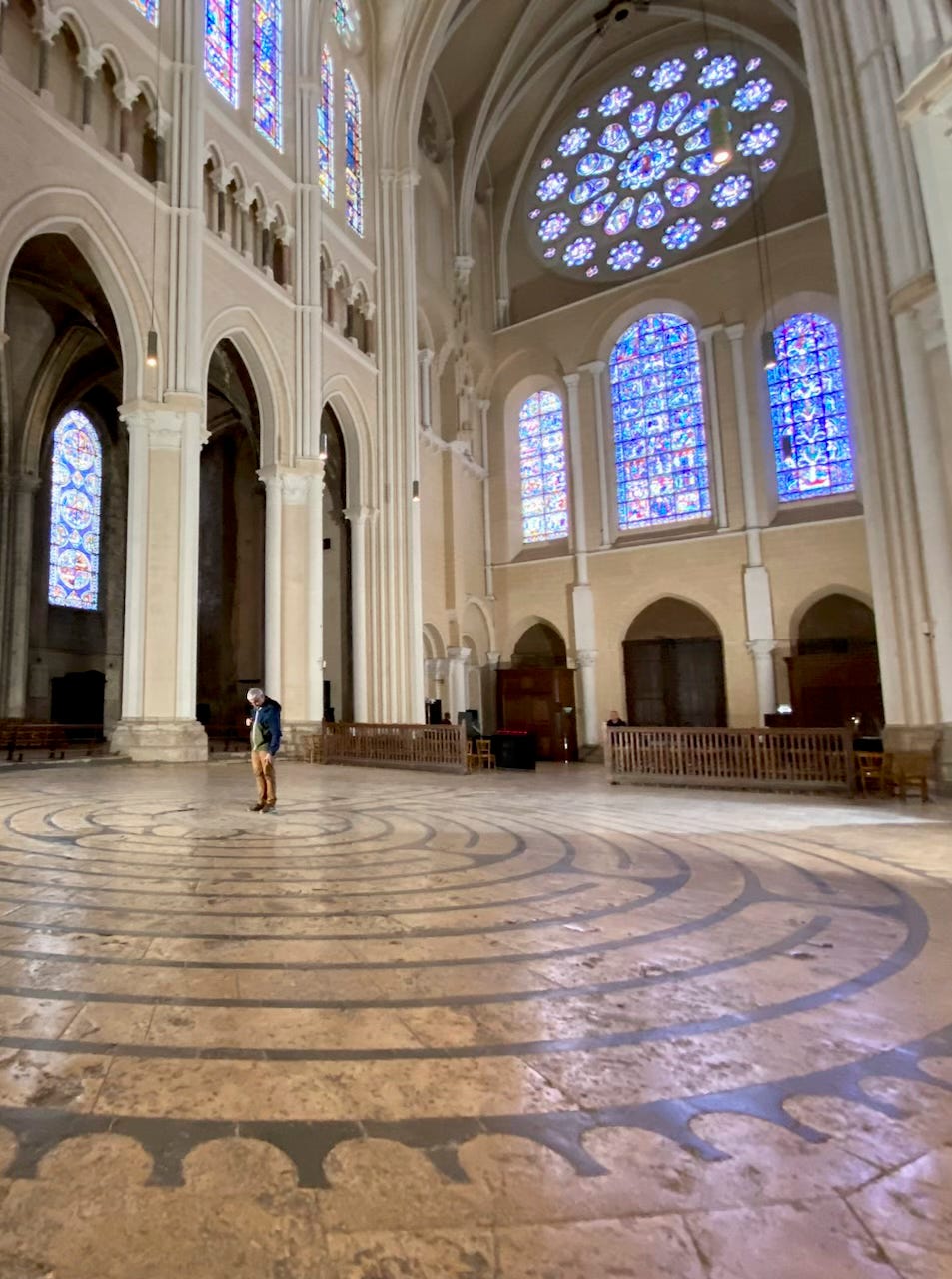
In the days that followed, our conversations turned toward the labyrinth as a portal into symbolic consciousness-now the most widespread and powerful mode of human meaning-making on the planet.
"Traditional religions have found symbols that capture the Whole of things from their perspective," Brian began. "The labyrinth is a symbol that captures the whole universe in the same way."
"The labyrinth," Brian continued, "is a different kind of symbol. It isn't static-it lives through dynamism. It needs to be walked. It comes alive only through our movement and our willingness to engage its wisdom."
Lauren reminded us that the labyrinth is a sacred pattern that originated before the modern mind-body split-before the rise of Cartesian dualism. It speaks from a place of original wholeness to a wholeness within us that predates our divided ways of thinking.
One of the key cosmological insights we were exploring that week was that the universe has no single center. It is omni-centric, unfolding its rampant creativity everywhere at once and continuously breathing itself into newness from every point within itself. Every place, every moment, every being is a locus of emergence. Each of us, then, is a center of this vast and ongoing creativity-a unique and novel expression through which the universe enters the world.
To walk the labyrinth, I realized, is to step directly into this creative process of cosmogenesis. Each footfall participates in the magnificence and generosity of a universe unfolding itself through us.
Walking the Path
Thursday evening arrived. The sun had set. The cathedral was closed to the public. Our group had been granted the rare privilege of having the entire space to ourselves.
No footsteps, no voices of tourists. Just fifty pilgrims in the vast, ancient sanctuary, enveloped by towering stone walls and shadowed stained glass.
Lauren invited us to take a piece of paper and write down something we were ready to release. The first phase of the labyrinth journey had begun.
I wrote a few simple words. As my pencil moved across the thin paper, I felt something loosening inside me, a hidden door quietly swinging open. We approached the altar one by one and dropped our slips of paper into a small bowl of water. To our gathered surprise, the paper dissolved instantly, the words vanishing into the water.
Inside the cathedral, the ancient space glowed with warm candlelight. Tiny lights lined the path from the entrance to the labyrinth. Around its circumference, hundreds of small candles flickered, illuminating the ancient stones. From somewhere deep in the cathedral, a cello played a long, low note that vibrated through my being.
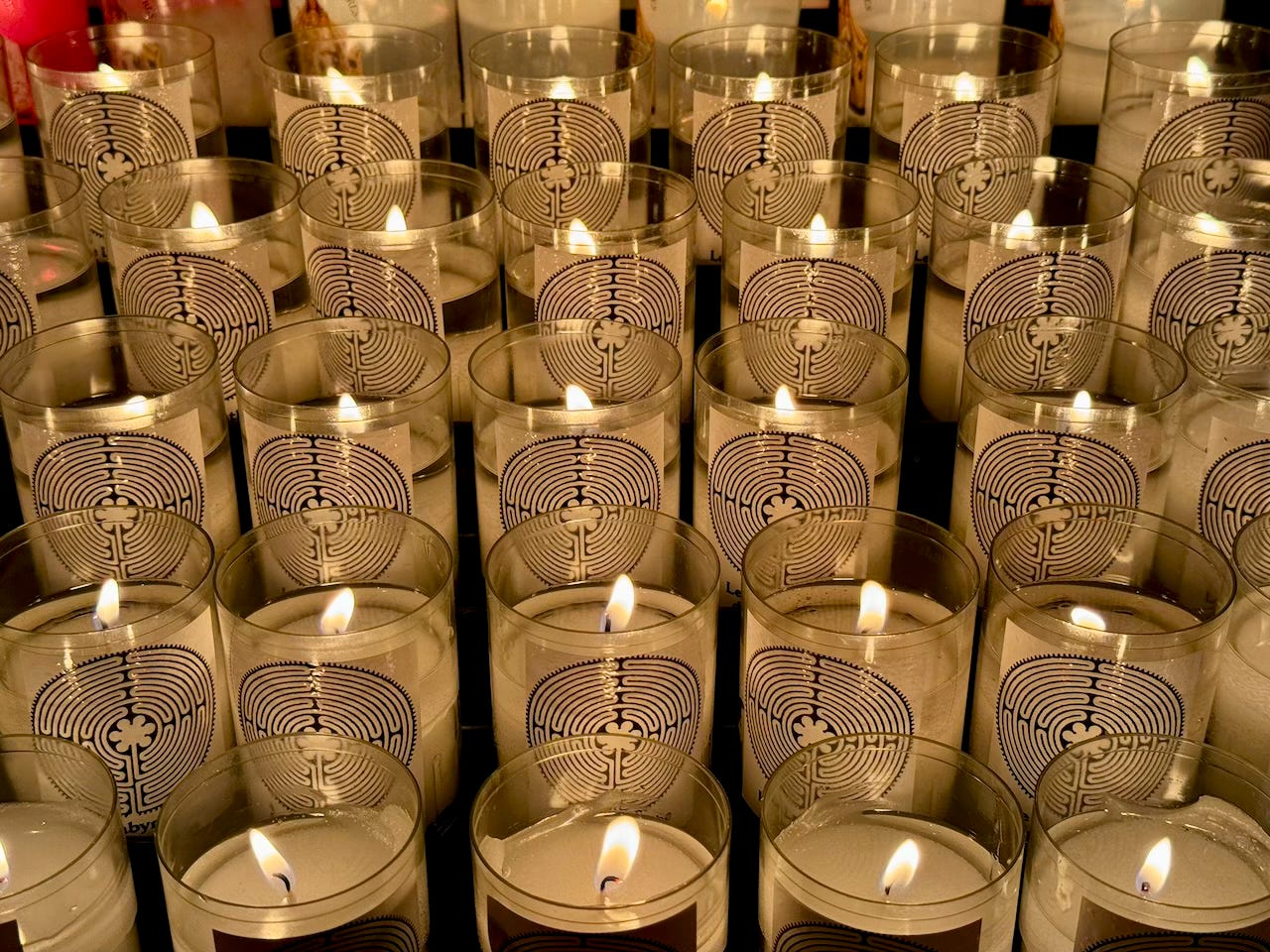
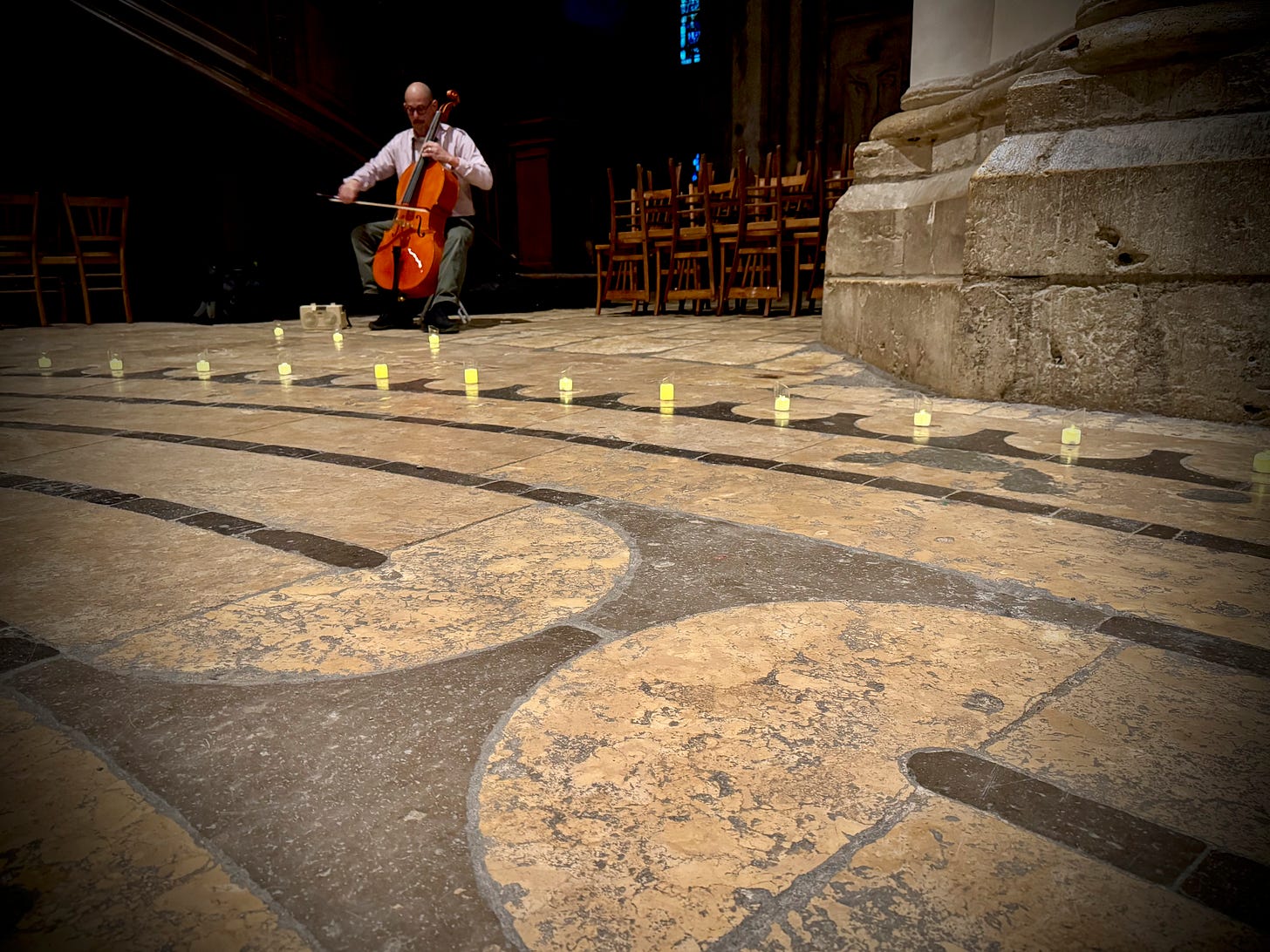
We had entered sacred space.
The labyrinth stretched out in front of us, its mysterious and ancient design fully revealed in all its glory. Lauren greeted each walker individually, spacing us so each person could move in their own rhythm.
Soon it was my turn. My heart beat faster as I took a deep breath and stepped across the threshold.
Immediately, the world shifted.
The floor was inlaid with hand-shaped white stones smoothed by time. My breath slowed. Thoughts, questions, and emotions rose and fell with each step as I moved into a rhythm beyond thought.
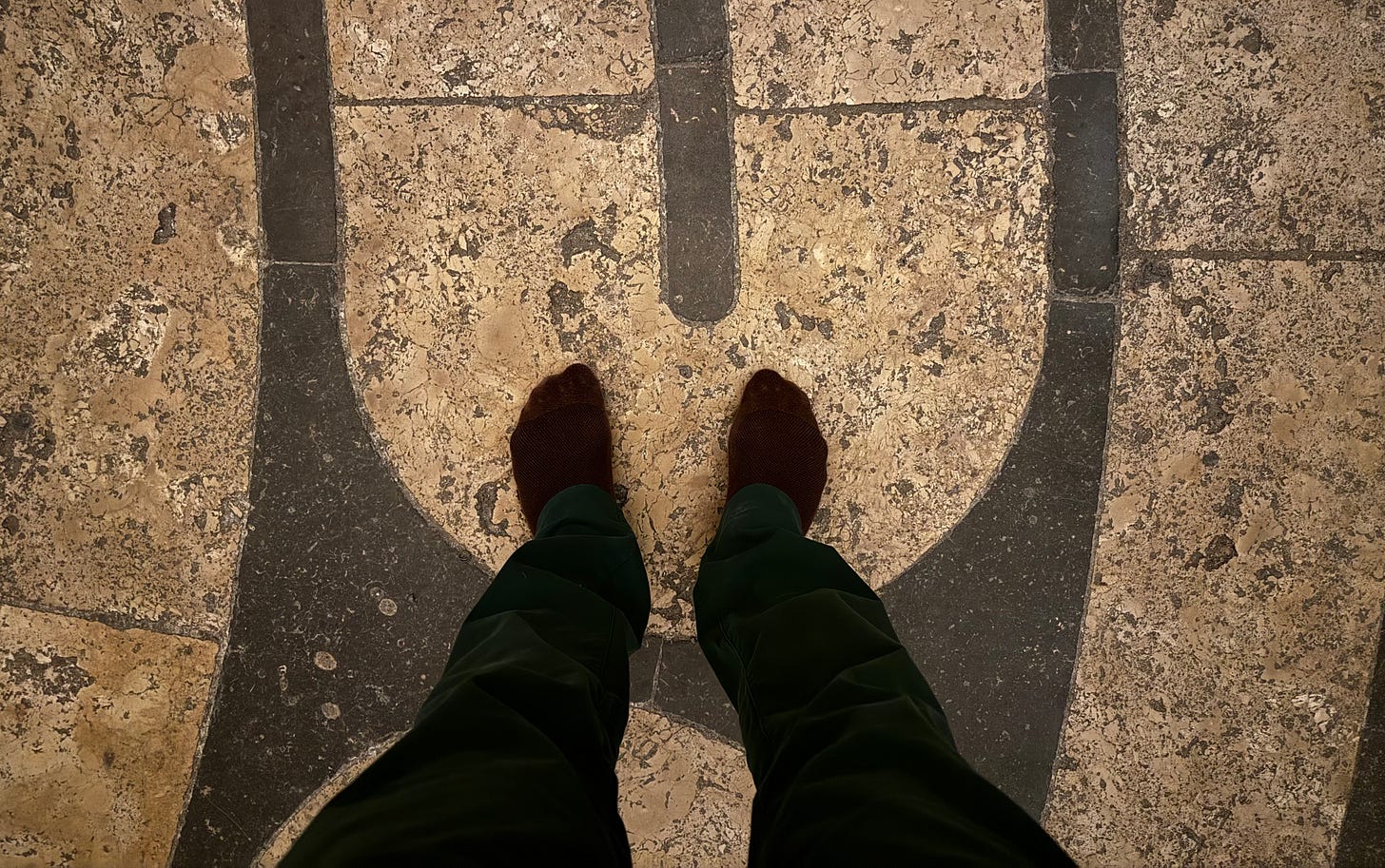
The walking path of the labyrinth stretches more than 900 feet, winding through eleven circuits before finally arriving at the center. As I continued, the labyrinth began to speak through sensation rather than words. The fears and stories I had written on the dissolving paper were only surface offerings. Deeper layers of identity began to loosen within me.
Astronomer. Scientist. Father. Husband. Son. Human being.
Each identity slipped away like grains of sand falling from an open hand. I felt myself becoming less and more at once-less defined, less bounded; more open, more free.
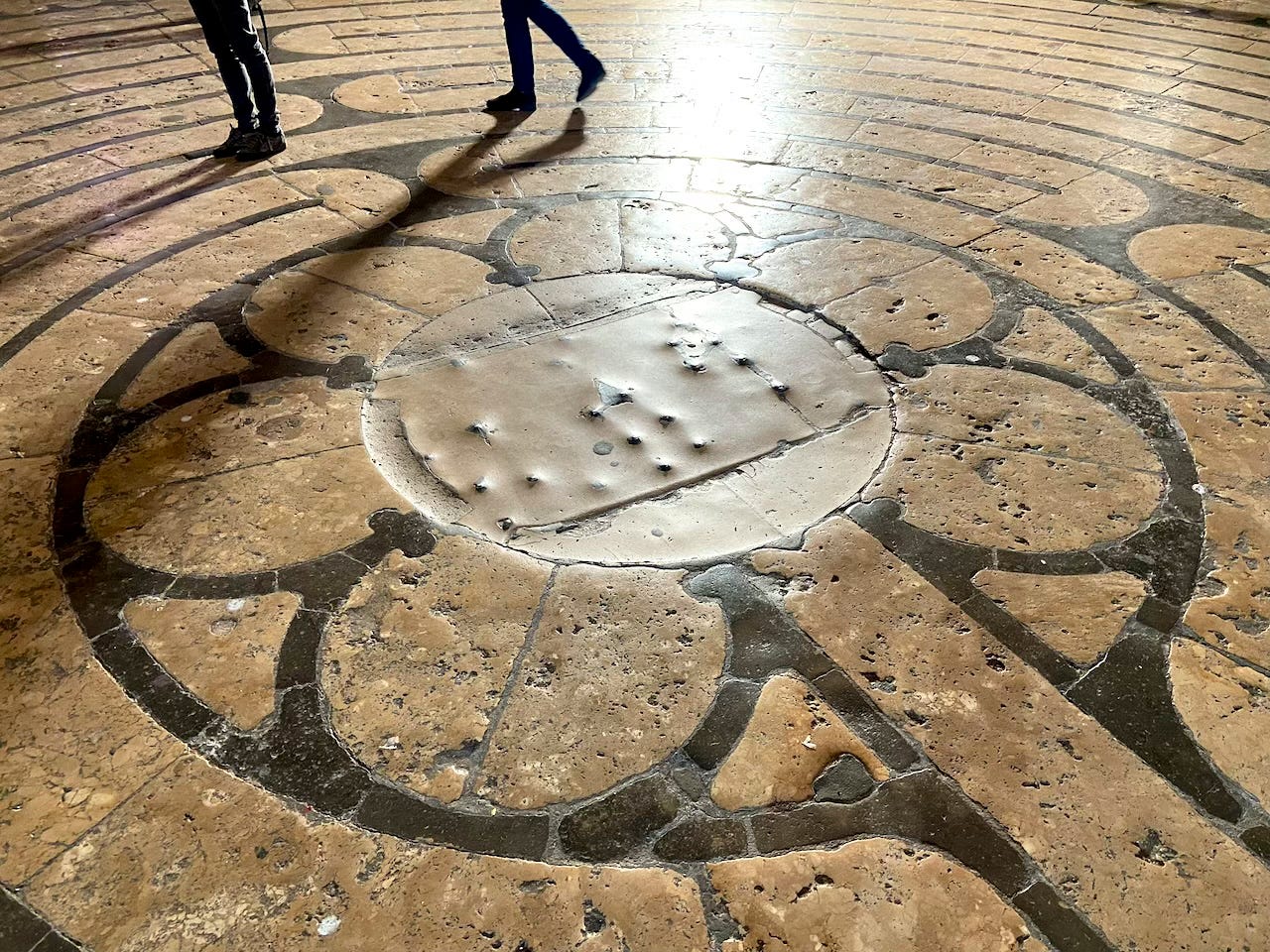
Eventually, I found myself entering the center, shaped like a six-petaled rose. I moved into one of the circular petals. Brian's earlier words echoed within me:
Experience is the primary way the universe presents itself to human consciousness.
And then something shifted.
A simple understanding-clear, quiet, and utterly unsurprising-rose up, like a whispered secret from the depths:
I am cosmogenesis in human form and always have been. So is everyone and everything.
It was a simple truth, very ordinary really, yet it shimmered through me like a silent thunderclap. I looked around at my companions and saw each of them in a new light, as unique expressions of the same unfolding universe.
I realized that I was a form of cosmogenesis that knew itself directly-an experience of the universe awakening to itself in a new expression of its unfolding.
I was not only in the labyrinth; the labyrinth was in me. It was in everything, just as everything was in the labyrinth.
Return
The last peal of insight echoed through me and faded into silence. I felt full and complete at the center of it all. Then I began my return, stepping outward from the center with a newfound confidence, each step rooted in mystery and in the cosmological imagination.
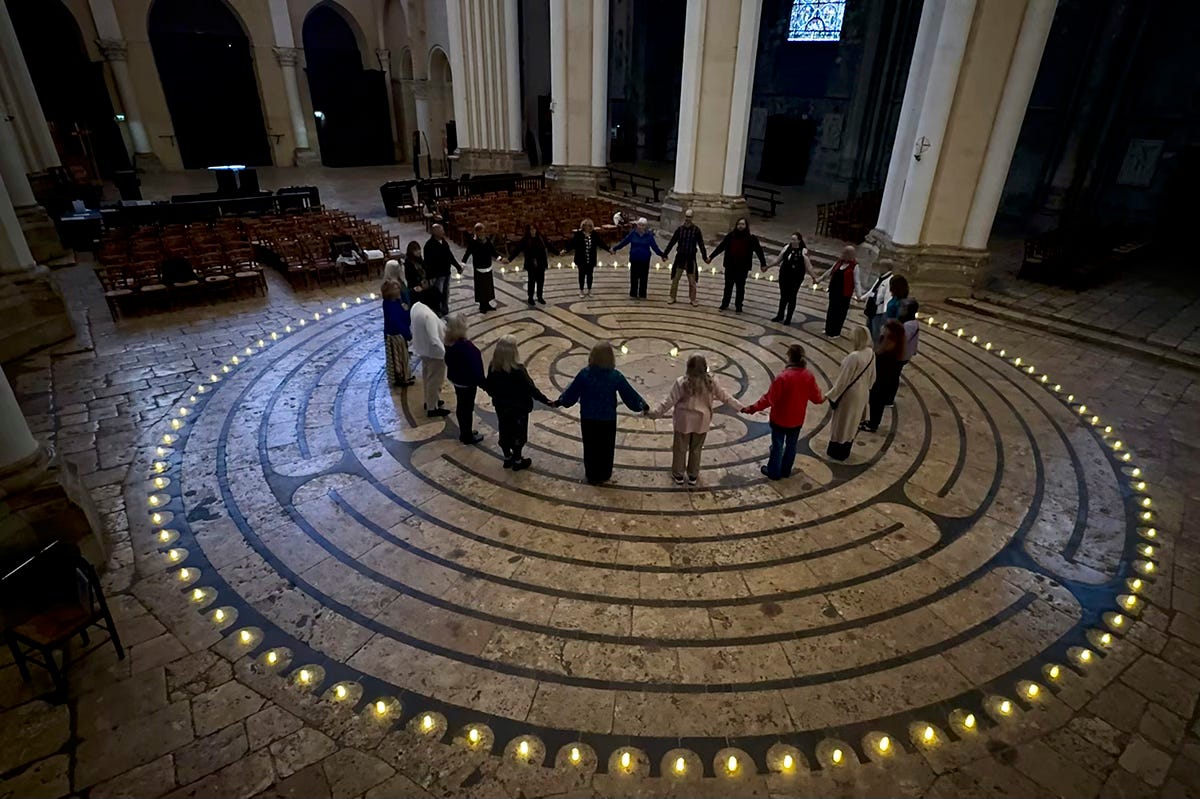
Before long, I found myself back at the entrance. Together we circled the labyrinth in silence, weaving a human border around its sacred form. I felt connected to everyone in the room, the building around us, and the universe that had given rise to all of it.
Lauren's voice broke the silence gently, yet with quiet authority and deep inner wisdom.
"The labyrinth has been here for eight hundred years," she said. "You are here now. In this place. Remember this moment."
The next day we gathered for a final time as a group. My fellow pilgrims looked both familiar and somehow more luminous. We had shared a pilgrimage in every sense of the word.
"Pay attention. Stay awake," Lauren said. "The secrets of the pilgrimage continue to unfold long after the trip is over."
I realized that the cathedral and its labyrinth were not separate from the universe that formed them. Both had emerged from the same creative dynamism that gave rise to stars, galaxies, and life itself.
Its winding circuits had inscribed themselves into me, revealing that pilgrimage is not a one-time event but a way of seeing and living within a creative universe that is itself on pilgrimage-ever unfolding, ever becoming.
We are each pathways through which the cosmos continues its long journey toward awareness, love, and wholeness. Like the labyrinth, though our path may twist and turn in unexpected ways, it always leads us home-to the center from which all things arise.
I'd like to thank Brian Swimme, Lauren Artress, and Orla Hazra for their generous comments, reflections, and thoughtful corrections on this article.