The Shaman and the Supercollider
Indigenous Wisdom, Modern Science, and the Craft of Everyday Life
As we sat in a circle in the refurbished gymnasium of the women's center I began to wonder what I had come here for. I knew only a little about indigenous African culture, and even less about shamanism, and so I felt a little awkward being here. We were all strangers, a diverse group with a broad range of ages, backgrounds, and worldviews, who had come together for a weekend workshop to learn about indigenous African ritual and how to cultivate a sacred relationship with our ancestors. The workshop leader was a modestly-dressed and unassuming man sitting on a folding chair who just happened to be an African shaman named Malidoma Somé. I'm not sure exactly what I had expected, but it was something along the lines of a large man powerfully garbed in a colorful dashiki with an ornately carved staff decorated with grasses and natural objects of power. But here he was, moderately sized with soft welcoming features, dressed in khakis with a casual shirt and light jacket, like he had just been out for a morning walk in the San Francisco sunshine and had stopped in to say hi and to pick up a paper and a cup of coffee. Then he started speaking about the capacity of indigenous language to alter physical reality and I knew we were in for a wild ride.
Malidoma Somé is a bridge between cultures. A native of the Dagara tribe of West Africa, he was raised in a traditional village before being abducted as a young child by religious missionaries and harshly indoctrinated in Western religion and culture. After his escape at age twenty, he returned to his people and underwent a rigorous initiation process he describes in his autobiographical Of Water and the Spirit. Through his initiation he reintegrated himself into his indigenous community and was eventually trained as a traditional medicine man and diviner. Later he attended the Sorbonne and Brandeis University where he earned several master's degrees and doctorates in political science and literature. If anyone in the modern world knows and understands the challenges of reconciling traditional indigenous wisdom with modern western culture, it is this man.
Bridging Worldviews
As a physicist and a teacher I have long been interested in understanding and bridging worldviews. In my classroom I have seen the difficulties students often have in grasping the revolutionary results of modern science and incorporating it into their daily lives. For example, modern physics has revealed that the matter that makes up our bodies, furniture, and everyday world is 99.999% empty space, yet many of us continue to live as though these objects (including ourselves) are completely solid and impenetrable. It seems our ways of relating to the world have not yet caught up with our scientific discoveries about its deeper nature.
Many science writers have speculated that perhaps this is because these new insights have been revealed through technology such as telescopes and particle accelerators that have extended our senses into realms we are not familiar with in our everyday lives. I suspect that this is partly true, but I've also noticed a similar difficulty with modern and indigenous peoples understanding and valuing each others' worldviews as well. This is particularly true when native peoples make claims about the nature of the world that are not readily apparent to the casual western observer. One example of this is the Dagara view that the world experienced during sleep and dreams is considered more real than the world of waking life, and is ever-present and available to us during our daily activities in waking life. For most modern people the reverse is true, with dreams considered largely insubstantial, fictitious, and sharply separate than our everyday world. What would it mean in the modern world to be awake and yet dreaming at the same time?
Perhaps more dialogue and open exploration of these areas of overlapping yet contrasting worldviews might reveal some ways of bridging the gaps between our western everyday experience, our modern scientific theories, and the viewpoints and beliefs of indigenous cultures around the globe. All of these viewpoints have great value and relevance for our contemporary world and the search for solutions to the pressing issues of our time.
Given the balance of power currently tipped in favor western culture this is not an abstract point. Indigenous cultures across the world are vanishing at an alarming rate, largely because their perspectives and wisdom have not been valued side by side with those of western culture and modern science. With the current social, economic, and ecological structures of the planet more and more stretched towards the breaking point, western culture might be able to learn a great deal about nature, sustainability, and community from traditional cultures worldwide, some of which have maintained their current ways of life for 50,000 years or more.
A Technology of Existence
As for my own contribution to this dialogue, I wondered what a modern scientist like myself begin to learn from the wisdom of indigenous spiritual traditions and culture? For starters, after tens of thousands of years inhabiting the earth indigenous peoples know a lot about the deeper nature of the world. The Dagara in particular have made astounding discoveries about the multi-dimensional nature of the universe on a par with those who receive Nobel prizes and have done so without the use of supercomputers and multimillion dollar research budgets. How? Part of the reason seems to lie in that they do not separate spiritual existence from mundane reality.
Malidoma Somé spoke of this in a recent interview, saying, "African cosmic consciousness, or awareness is one that is not distinct from mundane ways of existence. That is, one they have come to, [by] painstakingly living in nature and having to derive a certain sense of fullness out of nature, that [has] led them to being in the school of nature long enough to discover that nature has a very powerful dimension that is spiritual and by drawing from that they get the chance to acquire certain practical tools that are very useful for the conduct of everyday life."
This awareness of the numinous dimension of mundane life is something that has been largely lost in the West, where we often tend to separate technology, sustainability, and the sacred, relegating each to different parts of our lives, or at best, different parts of our week. For the Dagara and other indigenous African cultures, this is not possible. Learning to maintain an existence in the changeable and often challenging landscape of western Africa will eventually weed out those technologies that don't work on a daily basis, whether they are physical, cultural, or spiritual technologies. During our group dialogue on indigenous African wisdom, I was struck by how often Malidoma used the word 'technology' when speaking about Dagara rituals and spiritual practices and wondered how this might be similar or different than the way we often use the word in the west to refer to machines or other man-made artifacts with a purpose. If there were other kinds of technology that didn't use silicon or fossil fuels it would be fascinating to know more about them.
Somé uses the term "Indigenous African Spiritual Technology" to describe those skills, practices, tools, and rituals that are used to align mundane Dagara life with the natural and spiritual world in a sustainable and empowering way. These are the physical, psychological, and spiritual techniques that have been discovered and worked out over millennia that sustain and nourish the community and the culture in physical and spiritual harmony with their environment. They are a "technology of existence" that represent the art and science of living in the fullest way possible while aligned with the cosmic forces of a particular place.
The Dagara's expanded use of the word 'technology' to include the more-than-material world seems to reconnect it with its ancient western root, the Greek word techné, which means craft or art as applied in a practical way. Both uses seemed to share a sense of everyday applicability combined with pragmatic elegance and grace of living. What might the craft of living in the modern world look like, given the complexities and pressures of daily life in the twenty-first century? In the past few decades, our culture has relied heavily on the use of material technology as a fix to solve all manner of economical, cultural, and ecological issues, often with dubious or less than satisfactory results. What if other forms of technology might help, such as those in use by this ancient African culture? Might all these diverse technologies be eventually woven into a true techné for living and being in the modern world in a sustainable and satisfying way? It seemed worth considering.
Ritual as Resonance
For the Dagara however, ritual is the technological center of daily life. "Everything we do in Dagara culture has a ritual underpinning," Somé said as we began to plan our group ritual together. He pointed to the profuse numbers of rituals and shrines in indigenous culture, the cumulative effect of which is to create a certain mindset, that of the inseparability of the sacred and multidimensional nature of the universe and everyday existence. This to me, seemed to be a cosmology that is lived first and foremost, rather than discovered and learned.
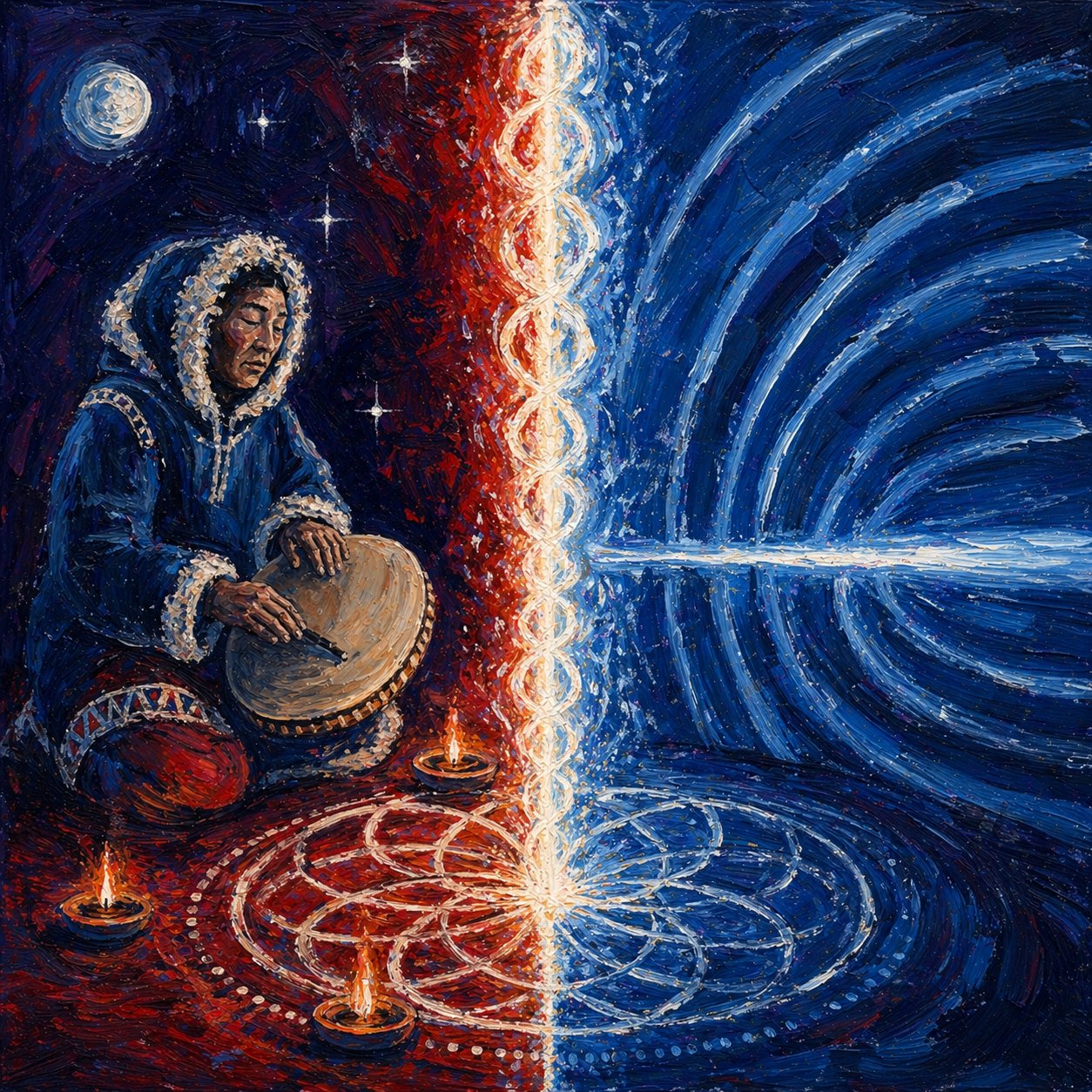
Ritual and community form the heart of Dagara spiritual technology. Through conscious and focused intention in a group in a ritual space, the conditions of existence can be altered such that new insights can arise, journeys can be undertaken, and the unchangeable can somehow be changed. We were gathered now as such a group on the Sunday afternoon of our weekend together to enact a ritual for honoring the ancestors, those who are now deceased but are considered an invisible and integral part of the tribal community, as much now as when they were alive. As the drumming started and our group's emotions began to rise, I could feel very much a kind of enlivening energy pervading the space of the room.
It struck me that this was very much like the focused attention of scientists at a particle accelerator, concentrating energy in such a small area that they can recreate the conditions of the early universe. In some way this is like opening a portal in time back to the beginning of the universe, through which the cosmos might speak and breathe new life into our equations and theories about existence. In the case of our own diverse group, we were hoping to open a doorway to our ancestors so that they might infuse our lives with their life-retrospect wisdom and larger perspective, and in turn that they might benefit from knowing that they were remembered by us the living. Plus, it would give the ancestors something to do. Malidoma said that the spirits of the dead can be quite restless and at loose ends at times, given their lack of bodies and the sensory richness that our world provides. "They like being given a task," he said, "they want to help."
As our communal attention deepened, we began to develop a rapport with each other and the environment, with even the previously nondescript gymnasium walls taking on a new familiarity and resonance with our ceremony. There was a "feeling with" each other during the ritual when we seemed to instinctively know what needed to happen next, spontaneously and with an unbroken grace of action. In physics, there's a process known as coherence, in which light waves can come into step together to reinforce each other, such as the resonance that happens in a laser when all the photons vibrate in the same way to create a great intensity of light. Today our ritual space has become the resonant chamber, with attention and presence becoming intensified in much the same way, capable of piercing through the ordinariness of everyday life as a powerful laser might bore through a solid wall.
Light, Matter, and the Deathless
The analogy may be more than metaphorical in this case, as the Dagara hold that the deeper purpose of human existence is to conjoin our world of physical matter with that of the light-realm of the ancestors, effectively bringing together matter and energy to recognize each other once again as one inseparable whole. When I heard this I immediately thought of Einstein's famous equation E = mc², which proposes something similar, namely that the universe can been seen through the lens of energy or the lens of matter, but that its deeper nature is something akin to both together. This paradoxical embrace of opposites is well known in physics as an enigmatic property of light called complementarity, which reveals the true nature of light to be both wave-like and particle-like. Light is both matter and energy and yet something altogether more than either, much like ourselves.
For the Dagara, the result of this rejoining of matter and energy, of the sacred and the mundane, is a kind of deathless state, the recognition that our deepest nature exists beyond time and space, beyond the intransigence of sickness and the inevitability of death. In this state, matter and energy are said to recognize each other, as long lost twins might be reunited after a lifetime separated from birth. Yet, I reflected, is this something that needs to be done and accomplished, as with so many other things in life, or simply recognized, as many other of the world's great spiritual traditions have echoed and exhorted throughout the ages?
The answer for me lay in the collaboration of ancient indigenous wisdom and modern physics. For example, photons themselves are immortal in much the same way as our light body in Dagara cosmology. Photons occupy a unique realm in the physics pantheon that joins space and time together, and yet they inhabit neither exclusively. A photon may travel uncountable miles across the universe for billions of years and yet from the photon's perspective the entire journey took but an instant and was simply a walk next door. This is because while a photon is 'traveling,' it does not truly exist as a physical entity in our universe, but only as a mathematical potential that becomes real only when it interacts or encounters something. This enigma of light's behavior comes out of quantum mechanics, paradoxically one of the most successful theories of modern science, and yet one whose results have puzzled physicists for nearly a century. Light it seems, is evoked out of the pure potential of the universe in response to the specific conditions of each moment.
Without the need for advanced mathematics, the elders of the Dagara know this intuitively. Everyone is born with a gift, Malidoma explains, and it is the function of both ritual and community to evoke what exists as potential from birth within each person so that their gift may be shared to benefit the community and the world. Perhaps in some way each person's light body is their spiritual nature, evoked out of potential and into the ordinary world where it is expressed as their unique gift and destiny. Malidoma's own name expresses his gift, and means "befriends with the stranger/enemy." This has been the role evoked for him through the wisdom of his community and tradition, to bring together the deep ancestral wisdom of Africa with the powerful forces of the modern western world that are largely shaping our global culture today.
A Technology of the Soul
This seemed to be the gift that was being evoked in ourselves this afternoon through our participation as modern people in this ancient indigenous ritual. As we visited the shrines we had built to honor the elements of nature and our grandfathers and grandmothers we were given the gift of reconnecting with our own indigenous nature, the reawakening of our own connection to the spiritual nature of the primeval world. We had begun to befriend our aboriginal selves, who had been long exiled from our innermost being for not having a place in our modern daily life. For contemporary peoples there is no greater gift as there has been no greater loss in the western world than the loss of the soul of nature and our spiritual connection with the natural world. Modern writers and philosophers have phrased it in various ways yet all seem to agree that something essential in the soul of modern humanity has been left behind in our headlong rush into modernity.
Our group seemed to be living proof that for us to begin to recover something essential in ourselves we do not need to give up all the conveniences and benefits of modern life, but only to begin to recognize the deeper currents of existence that surround and flow through us. Even the physics that underlies the technology of mp3 players and microwave ovens seems to point to remarkable insights about the nature of things that could turn our world upside down in an instant if we really took in their meaning deeply. Yet here was this African shaman, dressed in western clothes, telling us it was possible to live a contemporary life while still connected to our roots, nature, and the spiritual world. He reminds us that there is a technology of the soul, a techné for living that has been remembered and cultivated for countless generations in the indigenous traditions of the world and even within our very own culture until recently. This technology is freely accessible to everyone, burns no fossil fuels, and creates a life that is meaningful, connected and deeply satisfying. The expressions of contentment on our faces and the feeling of community at the end of the weekend as we exchanged hugs and phone numbers seemed proof enough for me.
In a world stretched to its ecological tipping point by an overabundance of material technology a little soul technology could make all the difference.
Copyright 2015 Stephan Martin · First published in edited form as "Modern Cosmology and Indigenous Wisdom," Shaman's Drum Journal, 78 (2008)