Precious Opportunity
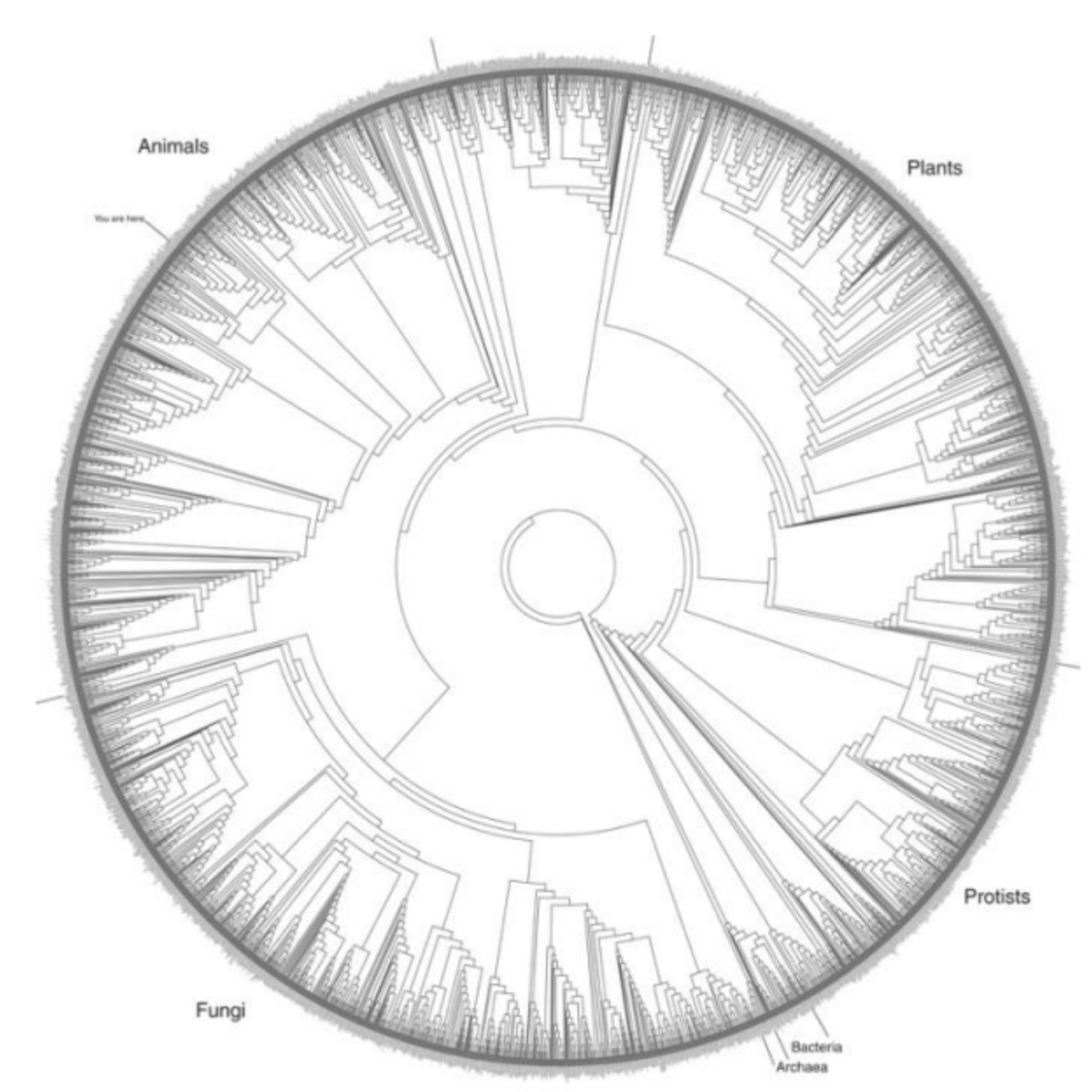
Congratulations. You made it. Welcome! Out of the estimated ten million or more species of life on Earth, you're here as a homo sapiens, one of the "wise ones." In the next few paragraphs, let me tell you a little bit about what it means to be human from a cosmic perspective and what it took for you to be here right now.
First off, you picked a great universe. Out of the perhaps infinite multiverse, you ended up in a cosmos that has just the right conditions for carbon-based life like ourselves to exist. Our particular universe has a nice balance of gravitational and electromagnetic forces and the energy levels in our carbon atoms are just about the right strength so that they can be made in stars. Have you seen the universe next door? Its expansion rate is a tiny fraction slower than ours, and the whole thing recollapsed before any stars could form. What a mess.
Not only did you pick a good universe, you chose a pretty good part of it to show up in. Most of the universe is...guess what? Empty space and dark energy. After that most of it is dark matter, whatever that turns out to be. You just happen to be the complex part made of heavy elements that were created by stars. You're part of the 0.03%! Well done.
Star Stuff
Let's take a look at the history of those complex atoms that make up your body. First of all, they weren't there at the beginning of the universe. They were made later in stars. Let me repeat that last part. The atoms in your body were made in stars. Yes, those beautiful shining points in the night sky are where your atoms were made. Here's the short version.
In the beginning of the universe, nearly fourteen billion years ago, the universe was filled with mostly hydrogen and helium gas. From this gas, the first stars formed, living bright but short lives that created elements such as carbon, oxygen, nitrogen, silicon, iron and a few others through nuclear fusion in their cores. The rest of the complex elements were created when these stars ended their lives spectacularly and exploded as supernovae.
In these massive supernova explosions, the rest of the complex elements were created and blown out into the galaxy, blending with other clouds of gas and dust. In this way, supernovae spread new elements around the galaxy in much the same way that a farmer will spread out fertilizer to cover his field. These fertilized clouds of gas and dust then form new stars made of slightly more complex elements, and the cycle continues, with each successive generation of stars forming from more enriched cosmic soil, creating the heavy elements such as carbon, silicon, and iron that can eventually come together to form solid planets like the Earth.
So the rich diversity of life we see around us is only possible because previous stars nourished the galactic cosmic soil and planted the elemental seeds from which life grew, eventually forming organisms like ourselves who can appreciate the wonder of it all.
The Long Thread of Life
Now that we've introduced life, let's explore a bit about what it took for you to be here as a complex life form. Four billion years ago, life was simple. Literally. The earliest life forms were likely prokaryotes, single-celled organisms composed of a simple membrane filled with organic goo. Quickly, however, they spread, multiplied, and evolved into perhaps a billion diverse species over the history of life, developing nuclei, specialized organs, photosynthesis, respiration, reproduction, and a myriad ways of crawling, covering, and infusing our little planet with a layer of living creativity.
Imagine the long thread of speciation that has led to you reading this text. Like a prokaryotic runningback coursing down a crowded field, this rough and tumble process of evolution sprouted limbs and fingers from flagella, lungs from gills, and skin and hair from simple scales and earlier membranes.
Whew. Take a breath. This is a rare capacity for life on this planet. Most of the living organisms on the Earth today don't have lungs, but take in gases and respire by other means.
Look around. The ability to see and sense the environment in complex ways is relatively recent in evolutionary history, having developed only after the Cambrian explosion some 530 million years ago. While this may seem like an enormously long time in human terms, it's less than fourteen percent of the history of life on Earth. Most of the time, organisms have been groping around in the dark without eyes or ears to learn about each other and the world.
Additionally, most of this groping led to a dead end. Current estimates are that over 99.99% of the species that have existed have gone extinct by now. Look around and admire the winners of the evolutionary race alive today, but don't gloat for too long, since many of these species (including ourselves) are continuing to evolve and change, and are likely to be gone soon in the bat of an evolutionary eye. Evolution seems to be a race with only winners of the moment and no finish line.
Showing Up Human
Now that you've shown up as human, it's no easy time either. Of the seven billion of us filling this planet, nearly eleven percent of us don't have access to clean drinking water and almost forty percent don't even have a toilet to use. The good news is that most of us (over 85%) can read, and increasing numbers are gaining access to basic education, sanitation, and health care, although progress in all of these areas has been frustratingly slow in many areas of the world.
So let's recap our situation here from a slightly different narrative. The atoms that make up your body began in the fiery furnace of the Big Bang nearly fourteen billion years ago, swirled around in stars for nearly nine billion years, until they showed up in the nebula from which the Sun and planets took their form. From there, they were in the Earth itself until they were taken up by the first organisms, then tumbled through a million varieties of life over nearly four billion years until they showed up in the form of the flesh and blood that you now occupy.
These atoms that were formed in the Big Bang have gone a million ways from Sunday since they began their journey nearly fourteen billion years ago. They've formed perhaps a trillion galaxies, each with hundreds of billions of stars. They've formed vast numbers of nebulae, asteroids, and planets, and perhaps taken shape in countless other forms of life spread across the expanding cosmos. But in all of this cosmic history and expanse of space, it's statistically extremely unlikely that they've ever formed anything like you.
This "you," the current form of this cosmic plenum, is a rare pool of complexity in vast arena of space, time, and universe. This form of cosmic life you call yourself has the absolutely astonishing property of being aware of and able to wonder at the miracle of its own existence. Remarkably, it's also able to make increasingly conscious choices that influence its own life and development as well as those of the countless others that make up the incredible pageant of life that share this planetary existence.
This gathering of cosmic dust that we call ourselves is unique among the countless worlds and stars of the night sky in that we have the potential to create new forms of life, beauty, and works of imagination never before seen by the cosmos, to express new ways of fostering compassion and care for others and even the planet itself, and to investigate, wonder and reflect on the majesty and nature of existence, discovering new ways for this evolving cosmos to know itself ever more intimately.
So tonight, walk outside and stand beneath the starry sky, surround yourself with the ancient light of the stars and the moon, feel the fertile Earth beneath your feet, and be still. If you listen very carefully you may hear this entire mysterious universe asking "What are you going to do with this precious opportunity of being human?"
Copyright 2015 Stephan Martin · cosmicconversations.org